If your idea of Florida living includes a boat in the water, quick access to fishing, and a home built to handle coastal conditions, Inglis and Yankeetown deserve a closer look. These small waterfront pockets offer a very different buying experience than a typical inland neighborhood, and that difference matters when you are comparing lots, elevated homes, and long-term costs. In this guide, you will learn what makes this area appealing, what to watch for with waterfront parcels and stilt homes, and how to evaluate a property with more confidence. Let’s dive in.
Why Inglis and Yankeetown draw waterfront buyers
For many buyers, the appeal starts with the water itself. The lower Withlacoochee River flows to the Gulf at Yankeetown, and public ramps in Yankeetown make it easier to get out on the water without relying only on private dock access.
That access supports the lifestyle many second-home buyers and anglers want. Florida State Parks identifies Yankeetown as a launch point for Waccasassa Bay Preserve, where boating and fishing are major uses, and the preserve is accessible only by boat.
You also have layered recreation beyond one single launch. The Withlacoochee Bay Trail adds boating access from Inglis Lock toward the Gulf, plus fishing opportunities along the canal and below Inglis Dam.
For you as a buyer, that means the value here is not just tied to a backyard view. It is also tied to how easily you can launch, fish, explore, and enjoy the waterfront day to day.
What waterfront lots look like here
In Inglis and Yankeetown, not all waterfront lots function the same way. A parcel’s usefulness often depends on shoreline width, elevation, and whether the site can support improvements like a dock or walkway.
That is especially important in Yankeetown, where shoreline improvements are regulated. The town treats docks, boatlifts, pilings, seawalls, and joint-dock arrangements as regulated improvements, and new residential docks are limited to one dock per 100 linear feet of owned shoreline, with footprint and height limits.
In simple terms, owning waterfront land does not automatically mean you can build the exact dock setup you imagine. A site may need a plan review, marine-contractor drawings, and permits or approvals depending on the work involved.
Yankeetown’s code also separates a water access walkway from a true dock. A walkway may be used for fishing, swimming, or observation, but not for vessel mooring, which can affect how you use the shoreline if full docking rights are limited.
Why stilt homes are common
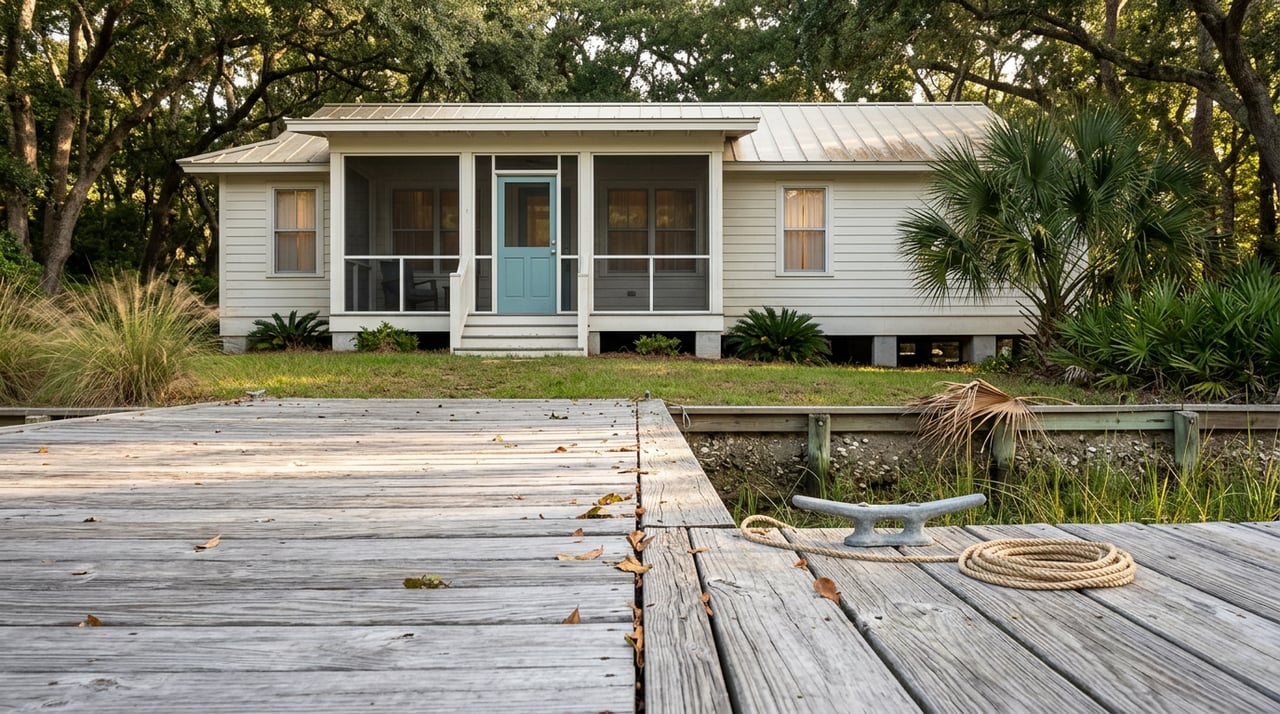
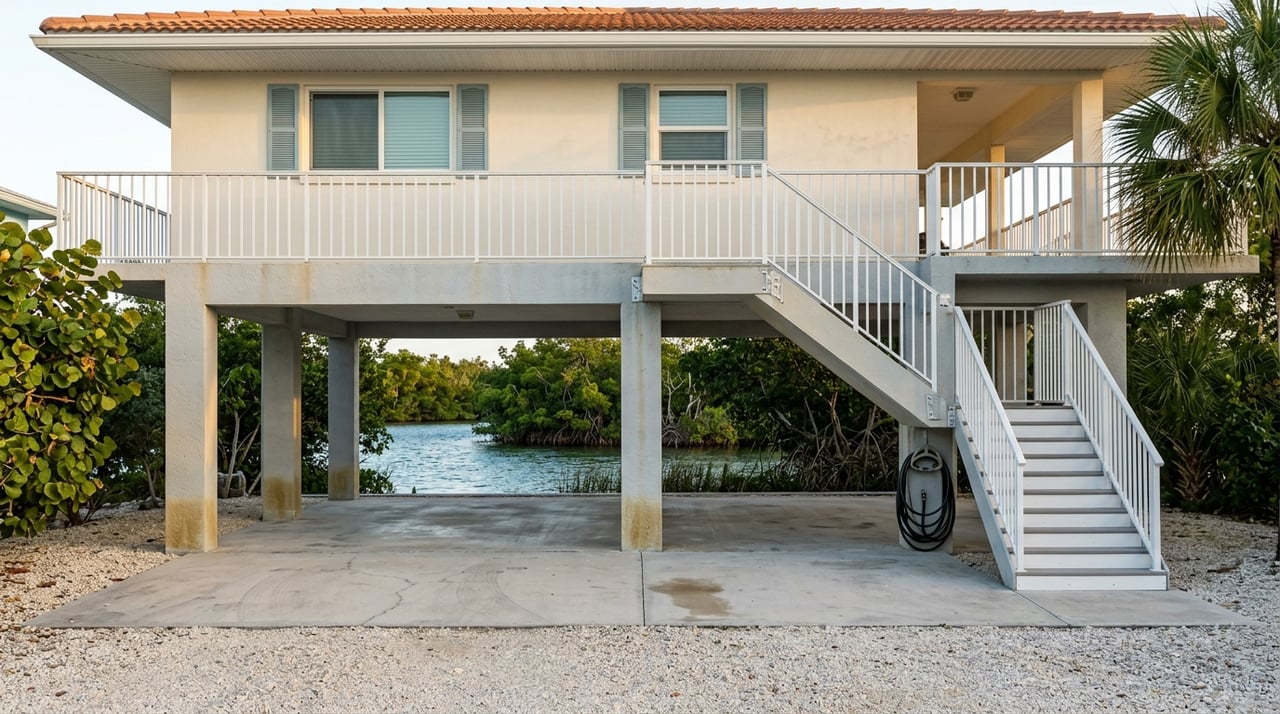
When you shop this area, you will notice that home design is shaped by flood rules as much as by style. Elevated cottages and stilt-style homes are common because the floodplain and coastal exposure influence how homes must be built.
That does not always mean oversized homes. Levy County says it has no minimum size requirement for one- and two-family dwellings, though the Florida Building Code still sets minimum room and fixture standards.
That flexibility can make smaller elevated homes more realistic on the right lot. If you are looking for a simple fishing retreat, second home, or lower-maintenance coastal property, that can open up options that feel more practical than a traditional large waterfront build.
Flood rules can shape the whole deal
Before you fall in love with a lot or home, you need to understand how flood regulations affect what you can build, remodel, insure, and finance. In unincorporated Levy County, the county flood ordinance uses the 2017 Flood Insurance Study and Flood Insurance Rate Maps as a baseline for flood-hazard areas.
The county also notes that even land outside a mapped special flood hazard area may still be regulated if surveyed topography shows it sits below the closest applicable base flood elevation. That means map review is important, but it may not be the whole story.
Levy County’s coastal plan adds another layer. It defines its Coastal High Hazard Area as the area seaward of the category 1 storm-surge line from the SLOSH model and directs development away from coastal high-risk areas where feasible, while also calling for higher floor elevations, buffers, setbacks, and other resilience measures.
In Yankeetown, local flood rules are especially important for elevated homes. Buildings in flood hazard areas outside Coastal A Zones must have lowest floors at least one foot above base flood elevation or design flood elevation, whichever is higher, and a similar one-foot-above-BFE standard applies in Coastal A Zones.
For coastal high hazard areas, the rules can be stricter. The lowest supporting structural members must be elevated above base flood elevation plus one foot or plus two feet, depending on orientation to wave approach.
Why lower levels are often open
If you see homes with open parking below, breakaway walls, or limited enclosed space under the main living area, there is a reason. Yankeetown’s code defines breakaway walls as walls designed to fail under storm-surge forces, which helps explain why enclosed lower levels are often restricted in how they can be built and used.
The town also says enclosed areas below elevated manufactured homes or below the design flood elevation must comply with flood-resistant construction rules. For you, that means the square footage shown on a listing is only part of the story.
You will want to ask which spaces are fully habitable, which are storage or parking, and whether any lower-level enclosure complies with current standards. That question matters for both safety and carrying costs.
Septic and drainage can make or break a lot
On waterfront parcels, the home site is only one piece of the puzzle. Septic feasibility and drainage can have a major effect on whether a lot works the way you expect.
Levy County’s river-protection rules prohibit septic tanks in the ten-year flood zone. In the 100-year floodplain, septic may be allowed if soil testing is completed and drainfields sit at least 24 inches above the seasonally high water table, with elevated drainfields required when needed.
That is why two lots with similar water frontage can have very different build potential. Before you buy land, it is smart to verify not just zoning and flood maps, but also septic feasibility and site conditions.
Insurance costs are highly property-specific
Flood insurance deserves early attention in this market. FEMA states that flood damage is usually not covered by standard homeowners insurance, so a separate flood policy may be needed.
Flood maps matter because they influence lender and insurance decisions. They are also only part of the pricing picture, especially for elevated homes.
FEMA says flood risk and premium calculations can depend on factors like proximity to a flood source, occupancy type, construction type, number of floors, foundation type, rebuild cost, and claims history. That means two waterfront homes that look similar online may carry very different annual insurance costs.
Elevation Certificates can help clarify that picture. FEMA says these certificates are used to evaluate a building’s first-floor height and adjacent elevation, help communities stay in compliance, and may help lower flood-insurance costs when more detailed elevation data supports a lower rate.
Why due diligence matters more here
In a neighborhood with standard homes, your checklist may focus on price, condition, and location. On waterfront lots and stilt homes in Inglis and Yankeetown, your checklist needs to go further.
You will want to evaluate three things together:
- Lifestyle value, including boating and fishing access
- Compliance cost, including elevation, docks, and site work
- Ongoing cost, especially flood insurance and maintenance
This is where a parcel-specific review becomes so important. A great-looking lot may still have constraints related to shoreline length, dock rules, septic, flood elevation, or permitting layers.
Check the jurisdiction first
One of the most important first steps is confirming the property’s exact jurisdiction. A parcel may fall within Yankeetown, Inglis, or unincorporated Levy County, and the process can differ depending on where it sits.
In Inglis, zoning approval must be submitted to the town before permitting proceeds, and the town notes that its building official is only at the municipal building every other Wednesday. Yankeetown, by contrast, maintains its own floodplain management and flood information resources, including a town floodplain manager and CRS coordinator.
That may sound like a small detail, but it can shape your timeline and next steps. If you are asking, “Can I build a stilt home and add a dock here?” the answer depends on the exact parcel, flood zone, shoreline configuration, and permitting path.
A practical buyer checklist
If you are considering a waterfront lot or elevated home in Inglis or Yankeetown, start with a clear checklist before you make an offer.
For waterfront lots
- Confirm whether the parcel is in Yankeetown, Inglis, or unincorporated Levy County
- Review flood-zone and base flood elevation information
- Ask about shoreline length and possible dock limitations
- Verify whether a dock, lift, seawall, or walkway already exists and whether it appears compliant
- Check septic feasibility, soil conditions, and drainage requirements
- Ask what permits or approvals may be needed for future improvements
For existing stilt homes
- Ask for available elevation information and flood-insurance details
- Confirm which levels are habitable living space
- Review the foundation and lower-level enclosure design
- Ask whether any additions or improvements were permitted
- Compare estimated carrying costs, not just list price
What this means for buyers and investors
For second-home buyers, this area offers a strong lifestyle case. You get practical boating access, proximity to fishing and marsh scenery, and a property type that often feels more connected to the coastal environment than a standard inland home.
For investors, the opportunity can be appealing too, but the numbers are sensitive to details. The combination of dock rules, floodplain standards, septic requirements, and insurance costs means your return can change quickly from one property to the next.
That is why local guidance matters. When you understand the lot, the flood profile, and the permitting path before you buy, you put yourself in a much stronger position to choose a property that fits your goals.
If you are exploring waterfront lots, elevated homes, or investment property opportunities along Florida’s Nature Coast, working with a team that understands both lifestyle value and property-level details can save you time and costly surprises. When you are ready to talk through your options, connect with Sugarmill Woods.
FAQs
What makes Inglis and Yankeetown attractive for waterfront buyers?
- The area offers access to the lower Withlacoochee River, public boat ramps, nearby Gulf marshes, Waccasassa Bay Preserve, and fishing and boating routes that appeal to second-home buyers, anglers, and boaters.
What should you check before buying a waterfront lot in Yankeetown?
- You should review shoreline length, flood-zone details, dock and walkway rules, septic feasibility, and the permits or approvals that may be required for shoreline improvements.
Why are so many homes elevated or built on stilts in Yankeetown?
- Elevated construction is common because local flood rules require certain floor and structural elevations in flood hazard and coastal high hazard areas.
Can every waterfront lot in Yankeetown have a dock?
- No. Dock rights and dock size are regulated, and a lot may face limits based on shoreline length, site conditions, and required approvals.
How do flood rules affect the cost of owning a stilt home?
- Flood rules can affect construction design, enclosed lower-level use, insurance premiums, and future improvement costs, so they play a major role in total ownership cost.
Why does jurisdiction matter for waterfront property in Inglis and Yankeetown?
- The permitting and review process can differ depending on whether the property is in Yankeetown, Inglis, or unincorporated Levy County, so the first step is confirming where the parcel is located.